Thursday, January 8, 2009

I didn’t fall of the face of the earth

I didn’t fall off the face of the earth. I did, however, fall into a place with more than 10 miles of road, more than 1 hour of daylight and more than 5,000 people (Ilulissat, Greenland), which is backhanded way of saying that there have been many reasons not to sit at this desk J. I am in Cape Town, South Africa. I am living in a ‘suburb’ called Observatory. It is considered a bit alternative, young and hip (you know, just like me). It’s only 3 train stops or 10 minutes in a mini-bus from the city centre and is really more like a residential extension of the city than a separate suburb.

A view of the city from Table Mountain.

Cape Town is full of stunning natural beauty, perfect beaches, amazing people, a certain amount of tension and unbelievable examples of contrast. Incidentally, it is also full of avid holiday-ers, who take three weeks off when Christmas and summer collide and explode into one, big, barbecueing, firecracker-lighting, late-night drumming and dancing, beach-going vacation. My lifestyle here laughs at my Greenland lifestyle (coming home from work at five and knitting until midnight). I also laugh. I hope you do as well :) I no longer feel like I’m 80, but I do feel like I should occasionally refuse a social invite, cultivate a bit more self-discipline and at least do some reading during this dead period, when everyone I want to interview for my research is at the beach. Formal research happens occasionally, but spontaneity has led me to new ideas, new friends, new research and a new confidence in the value of spontaneous decision-making …

Last weekend, a friend with a car (one of the best kinds of friends :) took us to the beach. Francois, the driver, is from Mauritius. He is white, with long, dirty-blond hair and thick, black-framed glasses. He studies film, if that gives some insight. He is eccentric and truly happy, which makes him (and his car) the best partners for a seaside adventure. Across the reggae-blasting radio from Francois sits Valerie, munching on potato chips, swaying with the music and yell-talking in Creole and French with Francois. Valerie is from Reunion Island, which is a country. I didn’t know that before I met her. Maybe you didn’t know it before you read that sentence. It’s near Mauritius, in the Indian Ocean, off the coast of Madagascar (http://www.vacationstogo.com/images/ports/maps/1187.gif). It’s French and volcanic and beautiful and yes, I think we should all meet up there. I have no plans in March (kind of)… Anyways, I am accompanied in the backseat by 2 broken windows and Jafar, a 29-year-old, self-proclaimed nomad from Cameroon and the Fulani tribe – “the cowboys of Africa”, he says. According to Jafar, Fulanis are the second most populous tribe in Africa AND they don’t dance, which is lame, I say. He asks what “lame” means and after a stumbling and giggling explanation, he returns to the French, car conversation and I stare out the window, choosing the speed and beauty and smoothness of the landscape over the beauty of the language I have always wanted to learn. I crane my neck to look straight up at the trees as we wind through Eucalyptus groves that remind of Hawaii and of how much I like trees (and missed them when I was in Greenland!). Soon enough, we wind down the mountain and into a small beachside town. My window-view is now interrupted by visions of wire and spikes mounted on 15-foot stone and plaster walls - turning beautiful, Dutch cottages into fortresses that spoke more of fear than of the quaintness and comfort usually evoked by cottage architecture. These walls are standard architectural elements in and around Cape Town – my house in the city has an iron gate and fence, as well as metal bars barricading every door and window (I need 3 keys just to get in the front door). That’s already absurd, but I could not understand why, in this little town of white-sand beaches and white stucco cottages, people felt the need to erect the same protections that we had in the city. And then I looked left. Literally across the road, the same metal that, in spike form, kept people out of the houses on the right, housed people on the left, in sheet-metal form, constructed to create small shacks that dot the dusty hillside. Tarps, plywood, sheet metal, old doors, old windows and shipping platforms were creatively combined to form one- or two-room shacks for 3 or 5 or 8 family members. Women sat outside on overturned buckets, laughing and talking and not worrying so much about the kids, who played together at whatever game they could create. “ajaaaaaa’ (Greenlandic for ‘ooooooo’ or ‘whoa’ or what in South Africa would be ‘shit, man’) was all I could say.

In my very limited experience of Cape Town, I have noticed this element of extreme contrast everywhere. Mountains tower over city buildings, exposing nature and urbanity, then dive into the sea, in a vertical/horizontal, immense/sublime contrast. People say that in Cape Town, you can experience four seasons in a day. I’m pretty sure I’ve been whipped through the city streets by four seasons in a matter of minutes: kissed by the sun, chilled by the rain, batted by the wind and pissed off at the clouds :) The brightness of day often brings warmth and the dark of night is cold enough to merit the fleece I wore in Greenland.

Of course, just 15 years after the end of apartheid, the light/dark contrast draws lines between more than just night and day. I spend most of my time here with a few African guys who live just ten minutes from my house, in a one-story cottage that has 7 bedrooms and 7 nationalities: Congo, Italy, Angola, Cameroon, South Africa, Zimbabwe and Mauritius. At any given time, one of these guys is not working, which means that I have an adventure partner for a trip to the beach, a museum, a penguin sanctuary… Usually we take the third-class train, which almost inevitably makes me the only white person around. And if we go to a nice beach or tourist site, the guy I’m with is almost inevitably the only black man we see. EVERYONE sees us – or so it seems. At first, I didn’t notice, wasn’t bothered and was honestly surprised at my own ‘color-blindness’. But in a few weeks time, I have learned to see color. It’s a little disturbing, but it also begins to explain why this society works the way it does - trying not to trip as it stumbles over the remnants of apartheid that have become a (sometimes) subtle part of public consciousness. I expected to come to South Africa and feel as aware of my whiteness as I did of my American-ness in Greenland. I guess I do feel white, but more than that, I am oddly aware of my friends’ blackness: uncomfortable for them when I am given the bill at lunch, when people on the hiking trail mumble and don’t make eye contact, when they get asked things like “so do people live in houses in your country?”. At the same time, though, our mixed pairings get us into places we otherwise might not go: I have escorts to the African market and the local fish and chips shack, while they have a reason to sit on the nice beach or stroll through the botanical gardens. And meanwhile, we can just laugh at everyone else’s discomfort and curiosity.

Victor, a friend from Angola, with South African penguins!!!

It was my own curiosity, in fact, that delivered me to one of the best places on earth, right here in Cape Town. Well, it’s about 30 minutes outside of Cape Town – pretty distant from affordable public transportation, jobs, the mountains, the beach, etc. It is called Symphony Way and it is a shack community in one of Cape Town’s largest and most distant townships. On my second day in the city, my only friend here (at the time. Now i have lots of friends. Tons. I'm probably the most popular person in this city) was going out there to do some interviews for his research. I still hadn’t changed or showered since arriving in the city, but spontaneity beat out my sense of hygiene and I asked to tag along. We drove out of the city, through the township, over the sidewalk at the corner where the old man sells fruit, onto the bicycle path to avoid the road block and then back again onto Symphony Way. The road is officially closed here and the roadblocks are unofficially erected and enforced by Symphony Way residents, who nonetheless cannot stop the police from driving through regularly.

Symphony Way ladies, strolling the road with me. I'm pretty sure I was teasing the girl on the end about having a crush on my friend, Emilio.

This is the edge of the township and the edge of a sandy bush area that boasted a healthy, green ecosystem before this township was built in the early 1990's. Now, the unstable sand whips down the street and through the tarps and plywood that residents have nailed and wrapped and leaned and constructed into houses that line this border between town and desert. On this border, this edge, this battleground of contrast and conflict between people and their government, live 120 families. These families, many of whom have been on the public housing waiting list for 20 or 30 years, illegally occupied government houses in December of 2007. They were evicted in February and rather than move into the government-provided shacks, they collected what they could of their belongings in the scramble of the eviction and set up across the street, on Symphony Way (check out their website at www.antieviction.org.za). They have lived here for 11 months, through winter and summer, an hour’s walk from school and jobs, without electricity and with one communal hose for water. And despite these incredible hardships, Symphony Way is one of the healthiest, most amazing communities that I have ever encountered - I would like to live in a place just like this. There’s no TV and no electric light, so most people draw amusement from strolling the road, visiting neighbors, sitting on makeshift porches and shooting the shit, talking politics, or organizing for the next demonstration. “It’s really a wonderful place to live,” one man told me, “because we all come from different places and have different stories, so we have so much to learn from one another.” Amazing. Almost as amazing as the children of Symphony Way, who, given their life situations and my own prejudices, I expected to be like those poor children in the Christian Relief Fund commercials (you know, give a penny a day and relieve the guilt of spending 100 times that on your morning muffin…). Not even a little bit like that.

Jafar (a friend from Cameroon) is holding Beyonce, the happiest child in the world who only occasionally likes looking at the camera...

On my first day in Symphony Way, I met the happiest child in the world. She came and crouched next to me on the curb and just looked into my face until I broke into a smile. She broke into a giggle and for the rest of the day, I carried this three-year-old on my hip, making eye contact and giggling with her every 30 seconds. We played jumprope, rugby (girls vs. boys, obviously), hopscotch and three sticks (line up three sticks and jump over them – you get creative when resources are limited) with the other kids until dark. Girls showed me their dance moves, sang the latest Rihanna hit and told me about their favorite colors, favorite school subjects, and dreams for the future. As the sun set and people rolled their makeshift, open-flame, gas canister/stoves outside to make dinner, we started a bonfire and drumming dance party. We left at 2 AM, promising to return for Christmas (a huge contrast to my other Christmas invite – of a 6 course dinner with some friends from work, which I just realized has been completely omitted from this post. Oops). I didn’t stop smiling for days and have spent many of those days trying to figure out how to incorporate this place into my formal research – something about religion and social movements, perhaps …

Making dinner. The little boy is Frankie. The last time I was in Symphony Way, he fell asleep on my shoulder when I was carrying him around.

In all of this contrast – of economic positions, of landscape and weather, of color and my own expectations – I am realizing that in every example, there are two distinct sides, with a bold line that divides and defines their borders. Maybe there is some way to twist this metaphor into a lesson about living peacefully with difference or appreciating the difference in contrast. I’ll work on that. But for now, I am simply trying to walk across those lines, boldly and smiling.

Sunday, December 7, 2008

Munching on Mattak


I know, you have all missed seeing my lovely face and glowing teeth. So I thought I would appease the masses (and practice some humility) by posting a picture. No, those black spots (which only accentuate the ivory white of my beautiful teeth anyway) are not rotting cavities, though with the amount of sugar I have been consuming, that's not an entirely unlikley proposal. The black is mattak, a favorite edible (questionably, in my opinion) of most any Greenlandic child. What is this lovely mattak?, you may be wondering. Mattak is the raw outer layer of fat and inner layer of skin on a whale - this particular dental disaster is narwhal stuck between my teeth.
How did I get narwhal stuck between my teeth? Funny story (and only funny because it ended happily, when I found the floss). About a month ago, a bit bored with life in Ilulissat and anxious to experience a less urban part of Greenland before I departed for warmer places, I pursued a trip to Uummannaq. Only an hour's
plane/helicopter ride, Uummannaq is one bay, one peninsula, one glacial ford or 28 days (on the icecap) by dogsled north of Ilulissat, the town where I was living. And somehow those geographical distances have crafted a town that to me felt very different from the bustle and drive of a rapidly developing Ilulissat. In fact, as I sat in the airport at the ned of my seven day trip, awaiting my flight home again, I was a bit regretful, wishing I could stay in this stunningly beautiful and fairly laid back seaside, mountainside town. As the helicopter landed, I thought: 'Hmm, I didn't think the shore here was quite so rocky, and how odd that it says Uummannaq on the airport sign (seriously, Kendell?) and how did the baggage collector from the
Uummannaq airport get to this airport so quickly?'. Right. It actually took a full 5 minutes, disebarking form teh helicopter and walking into an airport that looked exactly like the one we had just left (a single room with 4 tables and 2 chairs) for me to realize that indeed, it was the airport we had just left. I grabbed my bag and a ticket for the next scheduled flight (3 days later) and headed back
into town.
I stopped first at the Uummannaq Children's Home, a remarkable foster home whose children experience everything form European vacations to music therapy to springtime dogsledding with local hunters (http://www.bhjumq.com/UK/index.htm). I had been staying across the road at the new 'Uummannaq Polar Institute' (UPI), which is run by Ann Andreasen, the director of the Children's Home, and her husband Ole Jorgen, 'Greenland's greatest living native explorer' (http://www.meltfactor.org/blog/?p=22). Ann, a Faroe Islander who moved to Uummannaq decades ago, and Ole Jorgen, a Nuumiaq (from Nuuk, capital of Greenland) live in a beautiful blue house that is packed with local art, narwhal tusks, music, always guests, always tea, always cholate and always tales of Artic adventure. Actually, my main purpose in coming to Uummannaq was to present Ann and Ole Jorgen with the project I was developing in Ilulissat, to help archive the work of all the foreign researchers and reporters who are constantly flowing through town. UPI, Ann and Ole Jorgen's brainchild, serves as a residence and homebase for researchers in Uummannaq who in return for this incredible hospitality try to include the children across the way in their research. Many give presentations or take a few lucky students out to study sites. I made pizza. And on the particular evening when that stunning photo was taken, I was actually going to the Children's home to make chocolate chip cookies.
But if you're from Greenland, chocolate chip cookies have NOTHING on mattak. So I deserted that plan and took a slice, hoping my gag reflex wouldn't, well, flex. Actually, narwhal mattak is not so bad - I'd had beluga a few times already. It is sprinkled with Aromat, a salty soup spice, and eaten in one-inch-square gridded chunks. You chew it for a while, but you can't actually masticate all of the fat (that's why it's gridded - the knife chews for you) so at some point, you just give up and swallow those bits whole. And then politley decline seconds, which no one minds because it means more for them.


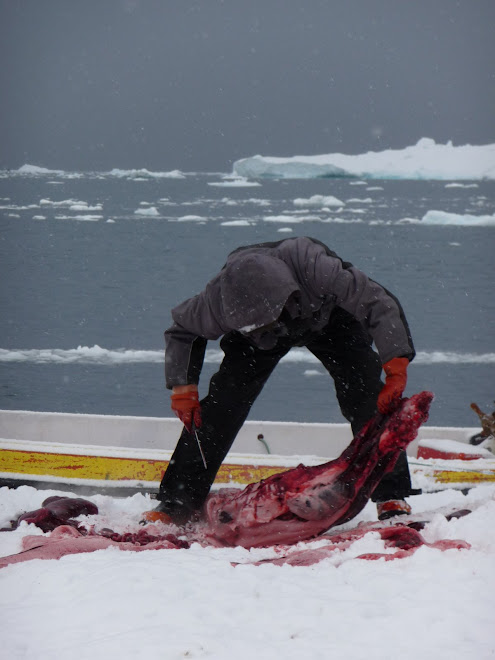
The mattak was a pretty rare treat of traditional fare for the kids and anyone else in town who was lucky enough to procure a fresh piece of the afternoon's hunt. The narwhals had only just made it as far south as Uummannaq, fleeing the ice, and Uummannaq's hunters had killed 10 of their 79/year narwhal quota. Determined to see the flaying of one of these whales, I climbed from the shore across the hulls of three boats, docked and empty for teh night. Four hunters had pulled their kill up onto a thick, flat iceberg and had begun the process of peeling away its skin and blubber, extracting organs, dividing ribs and finally, chopping off the tusk that would fetch about $100/lb of weight.


(Jens Ole, on the right, is from the Children's Home. He and the hunter on the left killed this narwhal)

Completely engrossed, I was gripping the boat railing with my sealskin mittens when the captain turned on the light in the cabin. He waved, I waved, and we went back to what we were doing until he came out and invite me in. We stood at the window and I asked dozens of questions to this English-speaking fisherman and
hunter. He had not got a narwhal today, but was hoping for one within the week that the hunt would last. When interviewing anotehr hunter earlier that week, I had been told that climate change was not the problem or concern at all - quotas were the problem. According to him, the government was restricting his livelihood and making it impossible for him to live off of his traditional work. He now worked part-time as
a hunter and part-time at the Children's Home, which is, admittedly, a pretty good deal and a fantastic opportunity for the kids.
Karl, whose boat I had commandeered for spectating, dsagreed that quotas were a problem. He liked that the quotas guaranteed the sustainability of traditional resources and food, so that future generations could still feast on mattak. Such feasts, of mattak and smoked halibut, narwhal meat, reindeer stew, seal soup and all the other traditional foods, were rare and precious. In many of my interviews and conversations, I would ask people what Greenlanders were most concerned about, if not climate change (and ALWAYS it was not climate change). Access to traditional food was the most common answer. For one, it is too expensive - tourists eat more traditional food than locals do because people simply can't afford it. For another, people don't have the time anymore to do (or in the case of younger people, to learn) things like smoking their own fish.
Why are we so attached to food, taste? Why is it such an integral part of a culture, a community? I wondered these things as I flossed my teeth and wished, just a little bit, that I could have made the cookies instead.

Monday, December 1, 2008

From Bowties to Revolution


Goooooodddaaaaay! From England! I know: be surprised. I was when I decided to come here a month ago. But there was an off-handed invite from a man on a ship in Greenland, and then the draw of many good friends and fantastic organizations doing and thinking everything I would like to be doing and thinking. So here I am, in a windowless computer lab at Oxford University, where there is more rain than sunshine, more bowties than sneakers and enough Harry Potter-ness to make you believe the kids in capes are actually off to a quidditch match and not a formal dinner. Why they where winged capes to dinner is another question entirely.

I arrived here on … Wednesday, I think – just in time for an ex-pat Thanksgiving of pheasant and duck, shared with two great friends from Williams. I am staying on the mostly sanitary dorm room floor of the mostly-smells-like-a-hockey-locker-room dorm of the entirely wonderful William B. Bruce, Jr. You should remember his name – he’ll be a powerful man one day, though perhaps less successful once people find out he lived in a smelly dorm … William is doing another (after graduating from Williams) bachelors of economics here at Oxford (paid for by Williams College), along with our friend Martin, who is on his second masters and headed for a PhD (also paid for by Williams) at Oxford. So between oddly intellectual and sometimes overly economic bar-room conversations, we toast Williams, who buys our drinks regardless of who picks up the tab J Thanks, Williams!

I spent my first day in Oxford trying to simultaneously recover from Greenland and adapt to Oxford. I bought makeup, leather boots and a real haircut (as opposed to my informal and sometimes disastrous attempts to fend off a mullet by giving myself bathroom-mirror haircuts in Greenland). It felt GREAT to hear my heels clinking on the sidewalk as I cruised through the shopping district, looking proud and purposeful. I was proud, but I didn’t really have anywhere to go. But who needs purpose when you look good?

After fending off the guilt and questioning for about 24 hours, I started to wonder about the culture of this place and what I was participating in and if I should participate and if it should feel weird or wrong or something. Yes, the thoughts were that rambling and confused. Walking through the street with my nose in the hair (and quite high in the air, when I wear my new boots – hehe), gazing into shops and thinking about evening plans and what to eat and what to buy, I started to really hate it. Everyone around me was doing the same thing – nose in the air, completely unaware of other people unless you happen to bump into them and step on their heel as you both rush down the sidewalk, to make your next appointment or just to get to the next thing, because that’s the point … I couldn’t handle the impersonality and self-centered pretension that seemed to be everywhere. That’s not to say that Oxford is a bust – it’s super fun and full of lots of wonderful people and beautiful courtyards inside stone college. But I haven’t worn the heels again and I haven’t gone shopping (except once, in London) and I think I’ve been a little grumpy and introspective. What am I doing here and what can I learn from this? Shouldn’t I spend this year exploring something totally different and how is this at all related to my research? Is this way of living wrong? Should I reject it in some way?

And then I woke up this morning and had the best day ever and mostly decided that my life is about the best thing that could happen to me, which is pretty lucky because it happens to me ALL THE TIME. First of all, it was sunny and I got to bask in beautiful warm rays while waiting for my train to Bath. Second of all, upon arrival in Bath (a one hour train ride from Oxford) I decided I would like to move there because it is so pleasant and cobble-stoned and full of cafes and of a different vibe from Oxford (in my completely subjective opinion). I had lunch in an upstairs café, where I took out my notebook to finish preparing for my afternoon interview and giggled when the mother of a 4-year-old-girl munching on chips over my shoulder told her daughter I was a writer and yes, she could be like me one day. Completely smitten and enchanted, I boarded a bus to Kelston Park and the offices of ARC: the Alliance for Religion and Conservation.

Martin Palmer welcomed me into his office with a huge smile and hearty handshake. He introduced me first to the coffin in the corner, then to the rolling, green grounds that have been distracting and enchanting everyone who approaches that window since the 1770’s, when the estate was built. Fantastic. (The coffin is from an eco-coffins project in South Africa. I just mentioned it to sound cryptic and intriguing. I hope it worked.)

‘Cup of tea? Earl Grey? Milk and sugar?’

‘That would be fantastic,’ I answer, astonished that he offered the one thing that always reminds me of England and my parents, who drink Earl Grey every evening after dinner.

We sit down at an old wooden table and Mr. Palmer starts asking me questions about my grant and why I am doing it and where I am going with it and many other things that are difficult for me to answer, but interesting to ponder and somehow safe to wonder aloud in the presence of his patience. Eventually, I stop talking and hear more about ARC, which is truly a fantastic organization. I thought everything was fantastic. In fact, I think he might have begun to think me disingenuous after I told him the grounds, the conversation, the organization, the biscuits, the tea, and the website, were all fantastic. If anyone has other words of praise you could lend me, I could use some variety in my excited vocabulary.

Basically, ARC’s mission is to facilitate and mediate partnerships between faith communities and the environmental movement. But beyond the basics, they do A LOT more [check out their fantastic website at www.arcworld.org], for which I am currently completely infatuated with them.

‘Climate change is not the problem, it is a symptom of the problem,’ Mr. Palmer proposed. ‘Climate change is a product of greed and consumerism, the assumptions that the planet is infinite and happiness is material.’

BING! Putting words to my confused experience at Oxford

‘The paradigm that produces climate change also produces poverty and inequality, it endangers species and it rips the planet apart.’

So, ARC is trying to imagine and create a different reality and a different paradigm, in which people learn to value not material wealth, but more modest contentment, because the earth isn’t infinite and ‘development’ and ‘progress’ as we know them are not sustainable. Why is religion the place to do this?

“Ultimately, the environmental crisis is a crisis of the mind. And likewise, appropriate development is ultimately an appropriate development of the mind. We see, do, and are what we think, and what we think is shaped by our cultures, faiths, and beliefs. This is why one of the more extraordinary (hey! They like this word too!) movements of the past few decades began to take shape. For if the information of the environmentalists needed a framework of values and beliefs to make it useful, then where better to turn for allies than to the original multinationals, the largest international groupings and networks of people? Why not turn to the major religions of the world?” (Palmer and Finley, ‘Faith in conservation. Yes, a book he gave me today).

And that is only part of why I twiddled and tweeted out of the 18th century estate with unquenchable smiles. In two hours of talking, Mr. Palmer filled my head with new ideas, my research with new directions (not the least of which is contacts in South Africa, my next stop) and my backpack with new books. I pranced the hour-long walk back into Bath – well, it was dark and my backpack was heavier, so I skipped carefully - wondering how I would explain to my economists back at Oxford that I had found someone else who thinks our economic paradigms are something between questionable and bullshit. Note to self: do not say such things to aspiring economists – it makes for unpleasant and uncomfortable dinners.

Now I am back at Oxford, where bowties are preferred to revolution, and most people have their noses just a little bit below Cloud 9 (where I spent my daytrip in Bath) and just a little bit above everyone else. I have two days here and then it’s off to Wales, where I will pick the brain of a man who is calligraphing the Bible and take long walks and hopefully spend lots of time catching up with his family (and this blog!)

Wednesday, October 29, 2008

Northern Lights


Some night sky shots from Adam's visit - neither my camera nor my ability to use my camera are capable of taking such pictures. Unreal, huh?


Thursday, October 23, 2008

The eyes behind the eyeliner

I just conducted a lesson with my ninth-grade students on the song ‘What do you see?’ by Black Fire, a Native-American punk-rock band. Of course, we couldn’t find a CD-player that worked, and when we did, the CD that I burned off my computer wouldn’t work. Apparently I am as bad at technology as the Greenlandic schools are. So we read the song as a poem. Levina, the bold and beautiful of the bunch, read out loud because her classmates nominated her. I had prepared some discussion questions that I had hoped would actually make these five girls talk and they sort of did … sometimes. Some of the questions were just clarifying unfamiliar words and phrases, others were about relating the ideas put forth in this song to the lives of people here, in Ilulissat.

What do you see? by Black Fire
You can go as far as any road

that you take how can you get anywhere
if you stand in your own way
take it for what you can
you take for granted what you don’t understand
what do you see?
and we find between these differences there's a very thin line
we see, what we were looking for was right in front of our eyes
you got to hold onto what you might lose learn what's not yet forgotten
when you know where you're from it's easier to find where you're going
it's your choice to carry on it's a part of who you are
sometimes we need to live a little more than we dream
leave this world a better place of unity
in unity
what do you see?

‘What does he mean when he says ‘see’? Does he mean see with your eyes? Or notice? Why is it important to do more than just see with your eyes, to think about things a bit?’ I begin, eager to see how the girls will react. They react in the same way you might expect a dieter to react to low-sugar, low-carb, organic, 7-grams-of-protein-and-no-fat coffee cake bar: a slightly sarcastic, you-expected-us-to-like-this, blank stare. They react as you might expect thirteen-year-olds to react to critically-engaged academic questions. Sigh.
‘Ok. What about this line, here,’ I reread the text, ‘What does it mean to ‘take something for granted’? What are some things that you think visitors to this place take for granted? What do you take for granted – perhaps something that your grandparents may not have had?’ They pitch I-don’t-knows’ and more blank stares: strike two for me.
‘Hmmm,’ I hum the m’s into a pause. Maybe today won’t be any different from every other day with this class. I plug on, a bit deflated. ‘What about when he says ‘Hold onto what you might lose’ and ‘learn what’s not yet forgotten’? What does he mean? What is the thing ‘you might lose’? History? Culture?’
‘I think he’s talking about culture,’ Levina answers. Whoa. For real? Thank you Levina!!
‘Ok,’ I push, after a long silence and some eye-rolling from Rosa, who is feigning sleep, her head on the desk. ‘Is this true in Ilulissat too? Do you need to hold onto culture? How do you do it?’
‘By talking. With grandparents or families. We have to remember,’ answers Parnaq, with some additions from Rosanguaq, who has suddenly decided that our conversation is actually more interesting than tracing a circle on the desk with her pen.
‘OK, so do you talk with your families about this? How do you learn about history and culture?’ I stumble a bit in excitement and momentary distraction from the stuffed birds I’ve just noticed in the cases behind Parnaq. Apparently the school AV room is also a natural history museum? And is also a Socratic seminar where they exile the American trying to do indigenous empowerment with 13-year-olds who seem (only seem!) to care more about dark eyeliner than about Inuit identity.
‘No’, they answer (to that question I asked in the last paragraph, before I went off on that tangential description). ‘We don’t talk about it at home. Sometimes in school. We can learn it from history books, sometimes.’
This seems a tragedy, for these Inuit kids to be learning about their cultural heritage from history books that probably give limited, biased and even racist information. Definitely a tragedy. But then think about it. When was the last time my family sat around the dinner table and discussed our Irish heritage or American culture? I don’t know. Maybe the problem here is my assumption that ‘talking about it’ is how kids learn about their heritage. You don’t talk about culture to learn it. You watch it, you experience it, you grow up with it, in it … It is ‘What you see’. (And anyways, I realize, this school doesn’t have any books. So that text written by some European trader in the 18th century and tragically pawned off on Inuit kids as cultural history doesn’t actually exist for my students. Phew, tragedy averted. Oh wait … no books?)
‘OK’, I hesitate a bit, aware that I am wavering on an academic cliff and though I’m ready to leap off onto some deep and important question that will make their minds and our conversation soar, I know that the wrong step will send me tumbling and crashing into a valley of ruthlessly disengaged, too-cool-for-school teenagers. The setting doesn’t help: this windowless museum of a classroom just about emanates sleepiness. Can you blame these girls? They’ve been sitting in 1.5 hour-long classes since 8 am.
‘Alright, take out your notebooks, did you bring your notebooks? No, of course not. Ok, turn over that paper that I gave you with the lyrics on it. For the next ten minutes, write down what you see in Ilulissat. It can be a list of things you see with your eyes, or it can be a paragraph and it can be about an idea, something you can’t see, but that you notice. Think about the things that are important to Ilulissat, what makes Ilulissat different or special.’
I try to busy myself. Oh! I’ll read that Manifesto from the Black Fire website. OK, done. Hmmm. Maybe I should write about what I see in Ilulissat? That’s a good idea.
Children on sleds; dogs; fresh produce in the grocery store; snow; hills; icebergs; warm hats … The bell rings for our mid-class 5-minute break. I go to the library to see if we can try using a computer to play the song.
I return and the girls haven’t moved. ‘It’s your break – you can go out if you like.’ I try to encourage them, afraid that they think they have to stay because I haven’t dismissed them. No one moves. Fine with me. What am I gonna do during break but twiddle my thumbs or talk with the English-speaking students?
‘How were your vacations? What did you do?’ I ask, referring to last week’s autumn break.
‘Sleep. Watch movies,’ Rosa replies in her usual monotone, which becomes all the more monotone when it reverberates off the desk her head is still lying on. ‘No, I don’t know what movies I watched. They were boring. I played Sims on my computer.’
Tragic or typical? These girls live in a beautiful town, surrounded by snow-covered mountains to the east, and iceberg-dotted ocean to the west. And they’re bored?! And they sleep and watch movies?! Oh wait, they are thirteen. And they live in a tiny town. And there is no mall. What would any 13-year-old girl do? It is tempting to pity them as victims of Westernization. But pity and victimization are as bad as ‘Westernization’ itself, in my opinion. I’m also tempted to say that we need to stop imposing their indigenous identity on them, expecting them to do the things that their ancestors did for centuries, from walking in the mountains to dog-sledging, to sealskin-cleaning and craftwork. That’s not to say that this whole situation isn’t really fucked up, that Western culture hasn’t bulldozed some very beautiful customs here. It is to say: it is not for me to feel nostalgic about the culture lost, it is not for me to judge, with my pity or my efforts to talk about cultural traditions, what is better: now or then, and it’s not for me to try to balance the two. Apparently it is for me to try to get these girls to think about all that.
We go to the computer lab, which is more 1990’s than it is ‘now’: a dozen ancient computers that actually can’t play sound. ‘It’s because we’re poor,’ Parnaq complains. ‘We’re not poor, the school is poor,’ Rosanguaq corrects. Odd, in a place with a 45% income tax rate, one would think that public services like schools would reflect the prosperity of the population. Anyways, the plan of listening to the music goes out the window. But we sit in a circle and conduct class in the lab, because at least it has a window … and no stuffed ducks to eavesdrop on us.
‘Dogs pooping,’ snickers Rosanguaq from her twirly chair. I laugh, the girls giggle. It’s funny, and true.
‘OK, you see dogs. They’re an important part of this place. Do you like the dogs - even though they poop?’
‘We love the dogs,’ Rosa shows some enthusiasm. She no longer has a table to lay her head on. So rather than sleep, she adapts to the new, more energizing classroom by racing and twirling around on her wheely chair. I move her to a chair sans wheels: she slumps. ‘There are too many dogs. There are more dogs than people. We should have less dogs.’ So much for excited Rosa.
‘I have six dogs. Well, my family does. My dad feeds them and everything, but he says they’re mine’ Levina offers.
‘I have a dog. And a cat and a fish’ – the only words I get out of quiet Bethina all afternoon. All but one of these girls has dogs. However, not one of them goes out dog-sledging, an essential Greenlandic tradition that makes travel and hunting possible even when everything is frozen over.
‘It’s too cold’
‘It’s boring,’ I’m reminded of David, my pant-splitting mountain guide, and his diatribe about modern kids who crave the stimulation of town over nature.
‘We don’t have time,’ Levina mumbles. No, they don’t have time. There are lots of things to do now, things that there weren’t to do fifty years ago. There are sports, school, and music, tv, clubs and computers. Then again, despite all of these things, they did have ‘boring’ vacations …
‘OK, no dog sledging. What else do you see, here in Ilulissat?’
‘Snow.’
‘Icebergs!’
‘Mountains.’
‘People change,’ Levina pops in, as though this statement needs no explanation.
‘Wait, ok. What do you mean, Levina, that people change? How do they change? In what ways?’
‘Like our parents, they’re not educated. Because when they were young, you had to go to Denmark for an education. And they didn’t speak Danish, so they didn’t want to go. They stayed and they’re not educated.’
‘And is that different now, is it changing?’
‘A little, I guess.’ I can’t figure out if this is a good change or a bad change, and Levina seems a bit ambivalent about it too. Education is a good change, but it still means leaving Greenland and probably following a Danish curriculum, which places strain on families and traditions.
‘Stupid people.’ Parnaq scoffs, ‘They’re so selfish.’ I cannot get her to expand on this thought. But I do offer that I am very impressed by them, that I don’t believe 13-year-old American girls would equate stupidity and selfishness, that selfishness is in some ways part of our culture. I was a ridiculously selfish 13-year-old. But here, this idea that selfishness is bad and stupid – that’s a bit un-Western, no? The Western sheen on this Greenlandic town dulls as our conversation continues.
‘Happy old Greenlanders,’ Rosanguaq reads from her list of what she sees.
‘Do you think old Greenlanders are happy?’ I push them.
‘No. They miss Greenlandic food. They’re only happy when they have Greenlandic food … and when they’re drunk.’ More giggles. More tragedy.
‘Not many young people that go out and hunt,’ Yes, Rosa! You are awake and you are thinking! I knew it! ‘Kids would rather drink, do drugs, sports, go to the club (there is one) … they want to do other things, not hunting.’
But why? I ask aloud and get little response. The girls maintain that this decline of hunters is bad, that more young people should go out hunting (mostly because ‘it tastes good,’ but also because it is an important part of their culture – both the acts of hunting and of eating the food hunted). The girls don’t, however, seem to want to take any responsibility for changing this pattern – by learning to hunt or going out on sledges. I wonder if it is partly a gender thing? They may not take responsibility, but at least they are thinking about it and about the challenges of balancing modernization and tradition.
‘I THINK THAT TOURISTS ARE MORE WELCOME IN GREENLAND THAN GREENLANDERS.’ I write this sentence in full on my paper as I try to engage all the girls in a discussion of this jolting piece of Ilulissat that Parnaq notices.
It’s expensive, they explain. Tourists eat more Greenlandic food than we do, because we can’t afford it. It’s true, given the cost of living up here. Greenlanders get paid shit, and salaries haven’t been adjusted in years. I’ve heard the same complaints from Karen, my co-worker, who asserts that more than climate change, Greenlanders are worried about being able to afford their traditional foods.
‘The politicians are stupid, they don’t know what we want,’ all the girls are talking now, offering their opinions on how politicians favor tourists over Greenlanders. ‘They only speak Danish. They want to make the country more modern.’
‘But I don’t want Ilulissat to become like New York City,’ Levina, the punk-rocker city girl defies my assumptions. ‘I don’t want Ilulissat to change. There are too many buildings and we can’t see the mountains anymore.’
There is so much packed into every one of their statements. Levina doesn’t want Ilulissat to become New York – a hilarious comparison in this town of 5,000 people and 6,000 dogs – despite the fact that she consumes so much of the modern culture that New York represents. She loves ‘the nature’ and wants to keep that quality of Ilulissat, as well as the way of living here, as it is. OR, even, as it was twenty years ago: ‘We should take away some of the buildings’, she trails off.
‘They’re always talking about tourists and how to make them feel good. They don’t talk about what we want.’ They sound like thirteen-year-old girls whining about their parents. No, they are thirteen-year-old girls whining about their government. Sometimes they don’t seem thirteen.
‘OK, so what do you want? If you were the politicians, if you could make decisions for Ilulissat, what would you decide? What laws would you make?’
‘No more buildings,’ Levina declares. ‘They’re blocking our view.’ This reminds me of Kent’s experience upon first arrival in Igdlorssuit. He was choosing his house site and realized that everyone had an amazing view – and coveted it. OK, yes, everyone everywhere wants a nice view. But even here, we can see Greenland peaking through the cracks of a Western modernity that might choose high rises over high icebergs. I’m trying to get these girls to wrench Greenland through those cracks … or at least to think about it.
‘More music,’ says Paarnaq. ‘We should have more music in this town. Like on Saturdays, we could play music. Any kind of music, with guitars and drums and … anything! We should have more instruments.’ Again, typical thirteen-year-old. But also, typical Greenland? The idea of sitting around and playing music on a Saturday, enjoying the company of friends and the joy excited by music and maybe the dances that would accompany it … It’s laid-back, it’s about enjoying one another’s company and creating beautiful things and comfortable social spaces. From my very limited experience here, from the books I’ve read and stories I’ve heard, this is very much in keeping with ‘traditional Greenlandic culture’. Perhaps it is even infusing those traditions with new elements: guitar, drums, a TV in the background, the American tourist who would sit, placid and curious, overanalyzing and trying to fit the whole scene into descriptive sentences that connect it in rational and meaningful ways with the past and the present and globalization and everything-that-was-ever-important… It’s silly but I can’t help it.
But then Parnaq gets a phonecall, which of course she answers in the middle of class because you do that here. She and Rosanguaq have to retrieve their bags, but they’ll be back before class ends in eight minutes. Mmm-hmmm, I think.
I can’t get the conversation started again, so I decide to count my blessings and move on. I turn to the computer and pull up Black Fire’s website. We look at pictures and try to play some of the music. We fail, of course. I remember the Black Fire Manifesto/mission statement (www.blackfire.net/) that I printed out earlier and, with three minutes and six girls (Rosanguaq and Parnaq have returned, and brought a friend), I decide to end class with these words. It’s a bit too long and a bit too heavy, I think. Most of the girls dutifully and swiftly shuffle out once I’ve finished reading. But I’ve given them some websites to look at, some music to listen to, and I hope they’re thinking …
After class, we talked about music. I played some Feist for them, off my iPod. They loved it. Feist (relatively well-known Canadian folk/rock singer) was in Ilulissat a few weeks ago, with an expedition of artists learning about climate change (http://www.capefarewell.org/). We check her website to see if we can find a blog post about her time here and what she thought of this place. These girls leave with more websites and more music. I wonder if we could write to Feist. Maybe she could help with the Parnaq’s Saturday afternoon music law …

Friday, October 17, 2008

'In the winter of 1932-33 affairs in America seemed as desperate as could be short of a complete breakdown of our whole industrial machine, and the chaos consequent to that. The breakdown was averted, and we enjoy today what we have termed Recovery. Yet even if Recovery be made a fact, we'd be unwise to relapse again into that unreflecting acceptance of prosperity which was, before the crash, the way of most of us. We've had our scare, a glimpse of the precarious, cardhouse nature of our social edifice; we've done some hard, fast thinking, most of us. What we have thought should be remembered, and in these days of change and revolution make itself a factor in our reconstruction. It may be that we have, as individuals, no voice or choice in the directing of our national destiny; that in the aggregate we must pursue, as water flows, a course determined by the contours of necessity. Yet the doctrine of economic determinism is far from being as determinative as it sounds. What is necessity? What do we need? And if we adopted toward ourselves, as individuals, or heads, perhaps, of families, the attitude of the physician who determines what we need by what is good for us, we might find our necessities to be of quite a different order from those to which we are accustomed and for the production of which our social structure has been reared.'
This a quotation from Rockwell Kent, copied out of his 1935 Salamina, a memoir of the year he spent living in a small village in North Greenland. Strange how history repeats itself, no? I mean, Kent, the great American artist, was in North Greenland, I, the great American ... Just kidding. But really, if we were to rewrite his opening sentence as 'In the fall of 2008 ...', the rest of the paragraph would be pretty believable. And his advice, when applied to the terrifying and explosive realities of climatic, political and economic changes today, would be both daunting and inspiring.
'What do we need?' Kent asks and, in ensuing chapters, describes how his experience of a simple life in Greenland taught him about all the gadgets and luxuries that he didn't need, as well as all the personal security that he only thought he'd had anyway. The book (which is VERY good, I highly recommend it) jokes and meanders its way through a year of unplanned life in Greenland, punctuated by celebrations of anything worthy (or unworthy) of celebrating, close encounters with death and ice, and basic, often joyful, living with the resources at hand.
Wouldn't he be surprised by Greenland today. Rather than find in this culture inspiration for simple living, without excess and sometimes without those things we assumed to be basic (example: any food source that wasn't harvested by harpoon, a.k.a. vegetables), Kent might be turning the question to the excesses of Greenlanders: 'What do you need?'.
In my experience thus far, which is certainly not universal but may be true for many who live in Greenland's bigger towns, there are a few essentials of every Greenlandic household:
1. A freezer, because you can only hang so much meat in grocery bags outside the kitchen window. Really though, frozen food has been a staple in Greenlandic diets for a long time. Last week, Marie froze seal kidneys and fat together - apparently it's just the best when fresh out of the freezer. She covets this delicacy the way I obsess over bread fresh out of the oven ...
2. Binoculars, especially if your house is on the shoreline, because there is always something out the window to look at and, given the expanse of things here, it is almost always too far away to see.
3. Thermoses to keep the tea and coffee warm. There is always coffee. There is almost always tea.
4. A big pot, to boil meat with potatoes, onions and rice, a dish called 'souaza'. I have eaten seal, eider duck, and halibut cooked in this way, all harpoon-harvested just hours before. It's possible that meat is served other ways. But who knows when Silver is at the stovetop - there is nothing traditional about anything he does. Did I mention that he was once in the circus?
5. A radio. The first thing Marie does when she comes home is turn on the national radio station (we only have two stations, the other is the local station). The radio gives news reports, plays music (Spice Girls this morning), hosts talk shows and, on Tuesday evenings, radio bingo!
6. A television. The first thing Silver does when he comes home is turn on the television. And the last thing he does before he goes to bed is turn it off. Sometimes this means 8 hours of tv. Sometimes I think I'll go crazy.
7. Cell phones. Everyone has them. Kids (tiny ones! I see 7 year olds on their phones) put music on theirs and play it while they walk or sled home.
8. Cigarettes. Everyone smokes. The 9th grade students I teach take smoking breaks during class. I saw a pregnant woman smoking the other day. EVERYONE smokes.
9. Alcohol. This is a touchy issue. Some say that people here don't drink anymore than people anywhere else, but that alcoholism is more noticeable because it's a small town. Others say alcoholism is absolutely out of control, that alcohol is involved in 95% of crimes here, that people are obsessed by it. It's about as rare to find a Greenlander who doesn't drink as it is to find one who doesn't eat meat. Meet Marie: an ex-vegetarian who hardly drinks! Except when Silver makes Irish coffee and serves us each two and we end up giggling into the morning at our sewing table in the living room...
I'm getting off topic. But it's fun. My point is, the list of things considered essential here, what people need, has greatly expanded in the last few decades. And this expansion has greatly affected what people do, how they live, how they relate to one another, how they pursue contentment. Take television, for example. Before TV, people in Ilulissat would visit each other in the evenings, gathering in a house's living room and chatting in a circle around the hosts, who would be going about such household taks as mending or cleaning a sealskin. Now there is a TV in this living room. If people do come by, the focus in the room is directed at the black box, conversation dies down a bit, picking up during commercials or when one of the dogs on Animal Planet does something really ridiculous like flip into a pool. And that's only if people come visiting, because if everyone has a TV, why not just stay in your own living room, where it's warm and where you have easy access to your coffee thermos and freezer of marine delicacies? The tradition of visiting, the way that people interact with one another, is changing.
'People don't go outside the way that they used to,' laments David, the somewhat dramatic, somewhat precocious 19-year-old that took me hiking on Wednesday. 'When I call my friends and ask if they want to go for a hike, they whine that we should just stay in town, watch a movie, play video games, listen to music, walk around. Sometimes they'll agree to go snowboarding - it's fast and exciting. But no one will just go for a walk.' I went for a walk with David and have to admit that I don't entirely blame his friends - he was leaping such distances between rocks that in my attempt to follow, I split the butt of my jeans! Hehehehe. But part of what he was getting at is that the pace of life is changing - his friends need the stimulation of television, town, video games, and have, perhaps, lost their ability or drive to find the stimulation and fascination that is so much a part of the natural world (in my opinion).
And in order to get access to some of these modern necessities, more people are moving into the bigger towns, which makes the towns even bigger and the likelihood of neighbors knowing one another even less. People don't say hi in the street anymore, David says. I've taken to trying to smile at everyone i meet when I'm walking. I quite like it, because most people smile back. But who knows? Behind my back (or in front of my face since I understand neither Greenlandic or Danish), maybe they're calling me 'that crazy American girl who is always smiling like a goon'. C'mon, guys! I'm just trying to build some community!
So. Enter television and other essentials of 'Western' living, exit the simplicity and community that Kent found in Greenland 75 years ago. Certainly, we cannot say that all the modern conveniences that Greenlanders have adopted are bad: Northface outerwear is warm, ice cream is delicious :), medicine saves lives. Even televisions can be great, as a learning tool that relays an awareness of current events and the world outside the isolated towns up here. Change, in itself is not bad. In fact, it is unavoidable. The trick, as Kent points out, is that we can control the changes that happen: determinism is not as determinative as it sounds.
In our attempts to direct these changes, we might refer to Kent's proposition that we consider whether 'what we need' is consistent with 'what is good for us'. In Greenland, it seems that sometimes, 'what we need' is eroding some of the most lovely traditions of this place. 'What we need' is changing how we live and therefore, how we think, how we dream, how we treat each other.
But of course, this phenomenon is not in secluded to Greenland - it's just been happening so fast here and is easy for me, an outsider, to see. These questions, of 'what we need' and 'what is good for us' are asked everywhere. I hope that many of you in the States have been pondering these questions, as the dipping economy threatens your access to those things you consider essential or your awareness of your carbon footprint compels you to ask if you really need a new car, teh banana trucked from who-knows-where, heat in your living room (hehehe). In addition to our economy and climate, Obama's campaign for change is sending us ricocheting through 'days of change of revolution', as Kent might call them. Right now, before November 4th, before our atmospheric carbon levels reach 385ppm, before we enter economic 'reconstruction' and the threat of 'relapsing again into that unreflecting acceptance of prosperity', there are so many reasons to think about what you need and what is good for you to need. Go for it! Turn off the TV and go outside, walk to the store and greet people in the street on your way (try smiling like a goon), turn down the heat and cuddle in a blanket (I was talking before about making new friends, but you might want to choose someone you are familiar with for this one). Maybe what we need is more splitting of pants in the mountains, goofy streetside smiling, and cuddling. Did the cuddling reference just make it too cute? If you want to learn more about paring down the things you need for the sake of your contentment and that of the global climate, check out http://www.epa.gov/climatechange/wycd/index.html
Also, leave a comment if you want! I love getting comments :) Or write me an email: kendell2leigh@gmail.com.

Friday, October 3, 2008

C is for cookie ...


This is Adam, with his almost indestructible camera. The black rectangle is a series of solar panels that help to recharge the battery.

'Oooo! Chaaaaaa-lie!! It's a glacier!' This is Marie, Silver's wife and my language and knitting teacher. We giggled throughout our helicopter ride...
For most of my life, the abbreviation 'cc' has hitched up in front of the word 'cookie' to represent one of my favorite things in the world: chocolate chip cookies. In fact, when I imagine those letters in my head, I imagine them jotted in Liz's slanted script, on a small scrap of paper with 'Log Lunch recipe' or 'Log lunch shopping list' scribbled at the top. But alas, when I made cookies this week (I've been thinking about this post title for a while, and the thought of it inspired me to bake, obviously), I couldn't find chocolate chips at the store. So I made chocoalte chunk cookies. Still delicious, FYI. But my point is that my imagination of 'cc' is changing the more time I spend in Ilulissat, in this Environment office, and in my own head, reflecting on it all ...

This morning I got out of the town, out of the office and out of my mind during a helicopter trip!!! Adam Lewinter, a researcher/photographer/engineer/adventurer extraordinaire, invited Marie and I to tag along on his research expedition to the faces of two glaciers. Yippee (we even brought our picnic spirit!)! We strapped into the 5 person flying machine at 8:30, glided over town and up the fjord, a few miles deep before we got to the face of the Ilulissat Glacier - the famously 'most productive glacier in the Northern Hemisphere'. I posted a picture of Adam at this site, checking on his camera. Adam works for the Extreme Ice Survey, who have, for the last few years, been photographing the recession of tidewater glaciers all over the world. They set up these cameras, boxed into hearty, weather-resitant, rock-resistant cases (emphasis on
'-resistant' and not '-proof' - they've lost 2 cameras to rock and snow falls). This shoe-box-sized camera armor also houses a timing device developed to make the cameras take pictures at regular intervals only when there is enough light. Every few months, Adam or one of his colleagues goes out, changes the memory card (this was our expedition) and presto-chango, they scroll through the shots and have a time-lapse record of glacial movement. OK, the presto-chango part isn't simple, but ... All of this is published on thier website (check it out! http://www.extremeicesurvey.org/).
The pictures become art; they become movies; they become research material for scientists and compelling images for people wondering about the changes that are happening in our natural world today. 'The best way that I can describe our work,' Adam tells me as we look out at an enormous glacier-born iceberg in the bay, 'is to say that we take you out of the perspective of human time, where changes are hard to see, and put you into glacial time'. I like the idea of glacial time ...
Yesterday, Adam came to one of the English classes that I've worked with at the adult education center in town. He brought a camera that the students could look at, as well as videos of huge calving events (when a big piece of glacier breaks off from the front edge/face and crashes into the sea, where it becomes an iceberg). My boss from the municipality, Mette, came along and helped to translate English-Danish for us, just to make sure everyone was following. We ended up staying for the entire 1.5 hours class and talking not only about Adam and Mette's work, but also about what climate change is, and what can be done to mitigate against it. We spent the last 40 minutes discussing the answer to one student's question: 'But what can we do in Ilulissat?'. Well of course, people here can do the same things as people anywhere: walk instead of drive, use CFL lightbulbs, turn down the heat, etc. But, the annual emissions of Greenland's 56,000 people are hardly a significant contribution to the global emissions (compare to the US, where 5% of the world's population emits 25% of the world's greenhouse gases). This isn't to say that people here should not try to live sustainably. However, it is to say that the margin of effective changes to be made here is relatively slim: there are only 600 cars for 5,000 people, houses are rarely more than 5 or 6 rooms ...
My thoughts on how Greenland can actually make a difference? It can send a message. Greenland is already a symbol in the climate change debate - I wouldn't be here otherwise. And by making changes here, Greenland can tell the rest of the world (that's you, stalkers of my blog) that people elsewhere also need to be aware of how they are living, consuming, emitting and changing the global climate. Hopefully you're thinking about it :)
I'm thinking about dinner tonight :) which I will share with Adam, Silver, Marie and Suzanne, the managing editor of Metro, a newspaper based in Denmark but also distributed in Boston and New York (I'm hoping to talk to her about some of the previous paragraphs, since managing editors are probably messengers ...). We're going to the 'Hotel Hvide Falke' (Hotel White Falcon) for the weekly 'Greenlandic buffet'. I am hoping for some seal meat (check out the photo below!), since I have yet to try it. Silver made a whale stew the other night for Marie, Adam and me. It was a delicious and hilarious dinner, in which Silver's life story attracted more attention than the novelty of a whale in my bowl.
There's NO WAY to tell about all of it or really to characterize this man - even he says 'Oh GOD! You wouldn't believe it. My life, there are things you don't know and if I told, you wouldn't believe it.' But he IS telling! And not only to his dinner guests, but also to 2 Italian authors who are writing biographies of his crazy life.
At the age of 19, he was playing keyboard for a very popular Italian pop-band. 'Five-thousand, ten-thousand, twenty-thousand people we had at EVERY show! And the girls! Agh, the GIRLS! They would be up there crying and wooing and kissing us,' he wiggles his arms like jelly above his head and dances around in what must be intended to be feminine.
He played music for more than 30 years, in various bands, in various parts of the world. He talks about summers in Greece, where he would go diving every afternoon before evening gigs. He came to Greenland in the 1970's, for a kind of random gig offered to him by a company he was playing for in Denmark. He fell in love here and never left. 'Kendy (yes, this is how he pronounces my name), you seem to be making some friends here,' he puts his hand on my shoulder and I smile back (I can count my friends on one hand), 'I just have to tell you one thing: do not fall in love here. It will ruin you.'
Silver is now 60 years old and, in the way a recovering alcoholic won't pick up a drink, this Italian rockstar will not pick up his music again. He quit over a dozen years ago, saying that the musican's life was destroying his family because it demanded crazy working hours and habits. When he put down his keyboard, he picked up tourism and he has been showing people around Ilulissat for about 15 years now.
I think he should open a restaurant and serve the incredible Italian-Greenlandic food that is helping me add a few layers of insulation to my body just as the winter rolls in :) I even promised I would teach him how to make my mom's cc cookies ...
**P.S. It took me a while to figure out how to post pictures, so there are some at the bottom of the page, too. Enjoy!